AI visibility software: what should you actually be measuring
A visibility score is easy to display. Knowing what drives it is harder.
If you are evaluating AI visibility software, the first thing you will probably see is a score.
That number can be useful. But by itself, it doesn’t tell an SEO or marketing team enough.
A useful AI visibility platform needs to answer the question of what is behind the score.
- Which prompts are producing visibility?
- Where is your brand being mentioned?
- When is it being recommended?
- Which competitors appear instead?
- Which AI engines are showing your brand?
- What sources are being cited?
- And where are you invisible?
These questions matter because AI search does not behave like a traditional search results page.
Ask an LLM or AI search system the same buying question repeatedly, and the responses can vary. The wording, context, available information and sources considered can influence what appears in the answer.
That makes AI visibility fundamentally prompt-level.
The real measurement question is therefore not simply:
“What is my AI visibility score?”
It is:
“Across the prompts that matter to my business, how often does my brand appear, how is it positioned, who appears with it, and what is influencing those answers?”
That is what serious AI visibility software should help you understand.
What should AI visibility software actually measure?
A platform designed for AI search should go beyond counting brand mentions.
At minimum, it should connect six layers of visibility:
Prompts → brand presence → recommendations → competitors → citations → opportunity
This creates a much more useful picture of how a brand is performing across AI-powered discovery.
For an SEO team, this also creates an important bridge between traditional SEO and newer disciplines such as GEO, AEO, AIO and AISEO.
- Your website still needs to rank.
- Your content still needs to be discoverable.
- Your pages still need to provide useful information.
But now the same content can also influence how an AI system understands, describes, compares or recommends your brand.
The software you use should help you see that entire picture.
1. Prompt-level visibility should be the foundation
The first capability to look for is simple:
Can the platform measure visibility at the prompt level?
This matters because AI visibility is not a fixed position.
There isn’t always a permanent equivalent of:
Keyword X = position 3
Instead, you need to know what happens when specific questions are asked.
For example, a SaaS company could track prompts such as:
- What are the best AI visibility platforms for SEO teams?
- Which AI visibility tools track competitors?
- What software can monitor brand mentions in AI search?
- Which platforms track citations in AI-generated answers?
- What are the best GEO tools for SaaS companies?
- Which AI SEO platforms track ChatGPT visibility?
- What should an enterprise SEO team look for in AI visibility software?
Each prompt represents a different potential discovery or buying moment.
A useful AI visibility tool should allow teams to build and monitor a defined set of prompts rather than relying on occasional manual searches.
That creates a repeatable measurement framework.
Why prompt-level measurement matters
Suppose your brand has strong visibility across broad category prompts but weak visibility across comparison prompts.
An overall score may hide that.
The prompt-level data will not.
You can identify exactly where visibility is strong, where it is weak and where competitors consistently appear.
This is one of the most important differences between AI visibility tracking and simply checking whether an LLM mentions your company.
2. Brand mentions are only the first signal
A serious AI brand monitoring system should tell you when your brand appears.
But a mention does not automatically mean meaningful visibility.
There is a difference between:
“Other companies include Brand A, Brand B and Brand C.”
and:
“Brand A is a strong option for this use case because,”
The second represents a stronger position in the consideration process.
That means AI visibility software should distinguish between basic presence and more meaningful recommendation visibility wherever the underlying response data allows it.
For marketers, this provides a more useful understanding of AI brand visibility.
You are not simply asking whether an LLM knows your company.
You are asking whether your company appears in the contexts where prospective customers evaluate solutions.
3. Recommendation visibility should be tracked separately
This is particularly important for commercial prompts.
Consider these questions:
- Which AI visibility platforms are best for agencies?
- What are the leading GEO tools for enterprise SEO?
- Which AI search tracking software should an SEO team consider?
- What tools can monitor brand visibility across multiple AI engines?
These aren’t purely informational searches. They are evaluation questions.
If your brand appears in an informational answer but disappears whenever the prompt becomes commercially focused, that is an important visibility gap.
A strong AI visibility platform should therefore allow you to understand visibility in terms of prompt intent.
This is where GEO becomes commercially useful.
Generative engine optimization is not simply about being mentioned by AI. It is about increasing the likelihood that your brand and its supporting information are surfaced in relevant generative answers.
4. Competitor visibility belongs inside the same measurement
Your AI visibility does not exist in isolation. If your brand appears in 20% of tracked prompts while a competitor appears in 48%, your ranking report alone may not explain the difference.
AI visibility software should let you compare your brand with relevant competitors using the same set of prompts.
Look for:
- Brand appearance
- Recommendation frequency
- Prompt coverage
- AI engine coverage
- Citation presence
- Competitor overlap
- Visibility trends
- Prompt categories where competitors outperform you
This creates a much stronger competitive view.
You can then ask:
Where are competitors being discovered that we are not?
That question can lead directly into content, authority and SEO decisions.
5. Citation tracking connects AI visibility to your website
A brand appearing in an AI answer is useful. Knowing which sources support that appearance is even more useful.
AI search systems can reference websites, publications, directories, reviews, research and other sources when generating responses.
That means an AI visibility tool should help identify:
- Cited URLs
- Citation frequency
- Cited domains
- Sources associated with your brand
- Sources associated with competitors
- Gaps in third-party coverage
This is where AI visibility begins connecting with SEO and AEO.
- Your traditional SEO strategy focuses heavily on making your website discoverable and useful.
- Your AEO strategy focuses on helping content answer questions clearly.
- Your GEO strategy considers how content and authority contribute to visibility in generative search.
Citation data gives you evidence about which sources are actually appearing in AI-generated answers.
6. AI engine coverage matters
AI search is not one platform. Your customers may encounter your brand through different AI engines and search experiences.
Depending on the platform and its capabilities, this can include systems such as:
- ChatGPT
- Gemini
- Claude
- Perplexity
- AI Overviews
- Other LLM-powered search experiences
That makes AI engine coverage an important evaluation criterion when choosing AI visibility software.
A platform that only checks one environment gives you a narrow view.
A broader system lets you compare visibility across multiple AI engines and identify where your brand performs differently.
This matters because a brand can have strong visibility in one environment and weak visibility in another. The difference itself can become an insight.
7. AIO measurement should connect AI answers with traditional search
AI Overviews have changed the relationship between organic rankings and visibility.
A page can rank strongly in traditional search while the search experience around that result changes.
For SEO teams, this creates an important measurement problem.
You need to understand both:
Where does my page rank?
and:
What happens around that ranking?
This is where AIO, or AI Overview optimization, intersects with conventional SEO.
A useful platform should help teams connect traditional search performance with AI visibility rather than treating them as completely separate disciplines.
For example, you may discover that:
- A page ranks strongly but has limited AI visibility.
- A competitor ranks below you but appears frequently in AI answers.
- Your content ranks for a keyword, but another source is repeatedly cited.
- Your brand is visible in AI answers for one prompt type but absent for another.
Those are actionable SEO signals.
8. AISEO needs more than another content score
AISEO is increasingly being discussed as the optimization of content for AI-driven discovery.
But a content score alone doesn’t tell you whether the optimization is working.
The stronger measurement loop is:
Optimize → track prompts → measure visibility → compare competitors → identify gaps → improve → track again
That is why AI visibility software should not stop at reporting.
The data should lead to decisions.
If your brand consistently disappears for a particular group of commercial prompts, the next question becomes: What evidence is missing?
Perhaps:
- Your website doesn’t clearly address the use case.
- Competitors have stronger category coverage.
- Authoritative third-party sources consistently reference competitors.
- Your content answers the keyword but doesn’t adequately address the broader question represented by the prompt.
The visibility data helps identify where to investigate.
9. LLM optimization should be measured through outcomes
LLM optimization is sometimes reduced to the idea of making content easier for language models to understand. That is only part of the picture.
The more useful question is:
Does the content and authority around my brand contribute to visibility when relevant prompts are asked? That requires measurement.
Track:
- Which prompts produce visibility
- Which prompts do not
- Which competitors appear
- Which sources are cited
- Which URLs are referenced
- How visibility changes over time
- Which AI engines produce visibility
- Which commercial topics remain gaps
This turns LLM optimization from an abstract concept into something teams can investigate through observable results.
10. The platform should show what changed
Historical visibility matters.
A single AI search tells you what happened once.
A tracking platform tells you what is changing.
For example:
Last period
Brand mentioned in 22 of 100 tracked prompts.
Current period
Brand mentioned in 31 of 100 tracked prompts.
That change becomes much more meaningful when you can also see:
- Which prompts changed
- Which competitors changed
- Which AI engines changed
- Which citations changed
- Which recommendations changed
- Which pages or sources were associated with the change
This is the difference between AI search monitoring and a one-time AI search audit.
What a serious AI visibility dashboard should answer
Before choosing an AI visibility tool, ask whether you can answer these questions from the platform:
|
Question |
Why it matters |
|
Which prompts mention my brand? |
Shows exactly where visibility exists |
|
Which commercial prompts exclude my brand? |
Identifies buying-stage gaps |
|
How often am I recommended? |
Separates presence from stronger consideration |
|
Which competitors appear instead? |
Reveals competitive visibility gaps |
|
Which AI engines mention my brand? |
Shows engine-level differences |
|
Which URLs are cited? |
Connects visibility with content |
|
Which domains are cited? |
Reveals authority and source patterns |
|
How has visibility changed? |
Shows progress over time |
|
Which prompts changed? |
Identifies what drove the movement |
|
Where should we act next? |
Turns measurement into strategy |
If a platform cannot answer these questions, its headline visibility score may not be telling you enough.
How SEO, AEO, GEO, AIO and AISEO fit together
These disciplines can appear to be separate strategies when they are actually connected.
SEO helps your website become discoverable and competitive in traditional search.
AEO focuses on creating content that clearly answers questions and can be surfaced in answer-driven search experiences.
GEO focuses on visibility within generative search and AI-generated answers.
AIO addresses visibility within AI-powered search experiences such as AI Overviews.
AISEO brings SEO thinking into AI-driven discovery and optimization.
LLM optimization focuses on improving how content and brand information can be understood and surfaced by language-model-powered systems.
The measurement layer connects them.
- You can rank well and still have weak AI visibility.
- You can have strong AI visibility around one prompt category and weak visibility around another.
- You can be mentioned but not recommended.
- You can be recommended but supported by third-party sources rather than your own website.
- You can outperform a competitor in Google and underperform them in AI search.
That is why the measurement needs to happen at the prompt level.
What should you look for when choosing AI visibility software?
If you are evaluating platforms, don’t start with the dashboard size.
Start with the questions you need answered.
Does it track prompts consistently?
You need a repeatable prompt set rather than occasional manual checks.
Does it measure competitors alongside your brand?
AI visibility becomes much more useful when you can see who appears instead of you.
Does it separate mentions from recommendations?
Being present and being considered are not necessarily the same thing.
Does it show citations and sources?
You should be able to investigate what information is supporting AI-generated visibility.
Does it cover multiple AI engines?
A single engine does not represent the entire AI search landscape.
Does it show historical movement?
Without history, you cannot tell whether optimization is actually improving visibility.
Does it connect AI visibility with SEO?
The strongest workflow should not force teams to maintain disconnected datasets for rankings and AI discovery.
Does it identify opportunities?
Reporting what happened is useful.
Showing where to investigate next is much more valuable.
Where PetalRank fits
This is the gap PetalRank is designed to address.
PetalRank brings SEO, AI visibility, GEO analytics, and search intelligence into a single platform so teams can look beyond traditional rankings and understand how their brand appears across AI-powered search.
Instead of reducing AI visibility to a single number, PetalRank gives teams a broader view across:
- Prompt-level AI visibility
- Brand mentions
- Competitor visibility
- AI engine coverage
- Recommendations
- Citations
- Cited URLs
- Cited domains
- Visibility trends
- AI query intelligence
- SEO and content opportunities
That creates a more useful workflow:
Track the prompts → see the visibility → understand the competitors → inspect the sources → find the gap → take action
The objective is not to generate another dashboard your team checks once a month.
It is to give SEO and marketing teams the information they need to make better decisions about where their brand needs to become more visible.
The real value is in what you can do with the data
Choosing an AI visibility platform shouldn’t come down to how impressive its headline score looks. The useful question is whether the platform gives your team enough information to understand what is driving that score and where to act next.
- If your brand visibility changes, you should be able to see which prompts changed.
- If a competitor starts appearing more often, you should be able to identify where that is happening.
- If your brand is being recommended, you should be able to understand in which contexts.
- If your visibility is supported by third-party sources, you should be able to see which sources are contributing to that presence.
- And if your brand is missing from commercially important prompts, you should be able to identify those gaps.
That turns AI visibility from a number you report into data your SEO and marketing teams can actually use.
The score tells you what changed. The underlying prompt-level data helps you understand where it changed, who is winning instead, and what deserves attention next.
See what your brand is actually winning in AI search
If you already track traditional rankings, the next step is not to replace SEO. It is to understand what your ranking data doesn’t show.
With PetalRank, you can track your brand across AI search prompts, compare visibility with competitors, monitor mentions and recommendations, investigate citations and identify the gaps that deserve attention.
See your AI visibility at the prompt level, not just as a score.
Check your brand with PetalRank
Start measuring the prompts that influence your next customer
AI search creates a new layer of brand discovery. Brands that understand that layer early will have an advantage because they can see where visibility exists, where competitors are emerging and where opportunities are opening.
Start with the questions your customers are already asking.
Track those prompts consistently.
Measure your brand against competitors.
Study the sources behind the answers.
Then use the evidence to improve your SEO, AEO, GEO, AIO and AISEO strategy.
Because the most useful AI visibility metric isn’t the one that looks impressive in a dashboard. It’s the one that tells you where your next opportunity is.
Ready to measure your AI visibility?
Track your prompts. See your competitors. Find your gaps. Start with PetalRank.
Frequently asked questions
What is AI visibility software?
AI visibility software helps businesses monitor how their brands appear in AI-powered search and LLM-generated answers. Depending on the platform, this can include prompt-level visibility, mentions, recommendations, competitors, citations, sources and visibility trends.
What should AI visibility software measure?
A useful platform should measure more than mentions. Look for prompt-level visibility, recommendation frequency, competitor presence, AI engine coverage, citations, cited sources and historical visibility.
Why is prompt-level tracking important?
AI-generated responses can vary depending on the wording and context of a question. Tracking defined prompts consistently gives businesses a repeatable way to measure where their brand appears and how that visibility changes.
Is AI visibility the same as SEO ranking?
No. SEO ranking measures where a page appears in traditional search results. AI visibility measures how a brand or its content appears within AI-generated answers and recommendations. The two should be measured together.
What is the difference between GEO and AI visibility tracking?
GEO focuses on improving visibility within generative search. AI visibility tracking measures the resulting visibility. In simple terms, GEO is part of the optimization strategy, while AI visibility tracking provides the measurement layer.
What is AIO in SEO?
AIO can refer to optimization for AI-powered search experiences, including AI-generated result features such as Google’s AI Overviews. It extends traditional search optimization to search experiences in which generated answers appear alongside or above conventional results.
How does AI visibility relate to AEO?
AEO focuses on making content useful and accessible for answer-driven search experiences. AI visibility measurement helps determine whether that content and brand information are actually appearing in AI-generated answers.
What is AISEO?
AISEO generally refers to applying SEO principles to AI-driven search and discovery. It can include optimizing content, entities, authority and information architecture while measuring how those improvements affect AI visibility.
Does PetalRank track AI visibility at the prompt level?
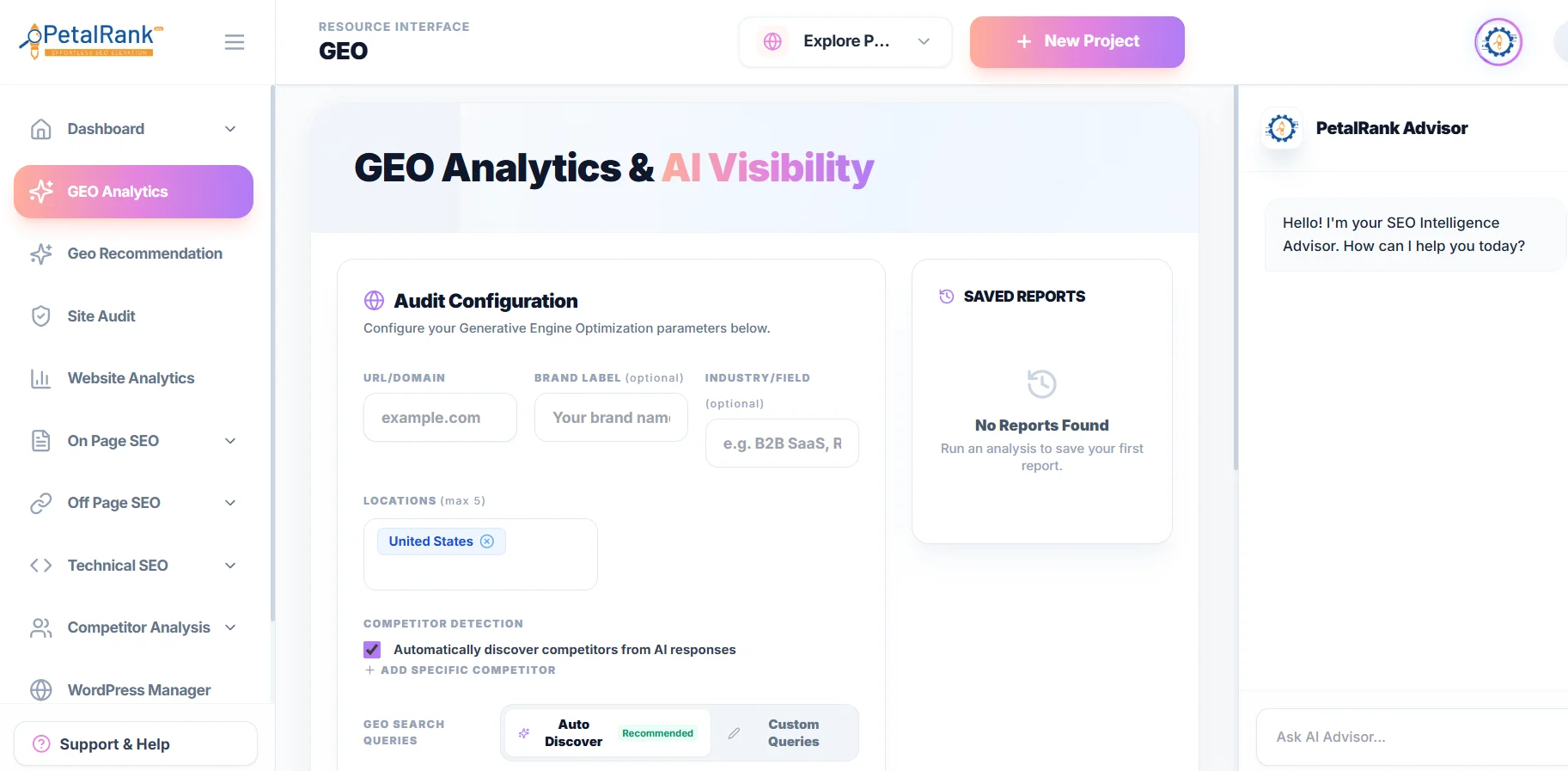
PetalRank’s GEO Analytics and AI Visibility capabilities are designed around AI query intelligence and visibility measurement, allowing teams to examine how their brand appears across tracked AI search prompts and engines.
Why should I track competitors in AI search?
A competitor can have weaker traditional rankings yet receive greater visibility in AI-generated answers. Tracking competitors alongside your own brand shows where your traditional SEO performance and AI search visibility diverge.
Is an AI visibility score enough?
No. A score is useful as a high-level indicator, but it should be supported by prompt-level data, competitors, mentions, recommendations, citations, sources and historical trends so teams can understand what is driving the result.
How can AI visibility data improve SEO?
AI visibility data can reveal content gaps, competitor strengths, citation patterns and commercial prompts where your brand is absent. Those insights can then inform content, authority, technical SEO and broader search strategy.
What should I look for in an AI visibility tool?
Look for consistent prompt tracking, multiple AI engines, competitor analysis, mentions and recommendations, citation tracking, historical visibility, query-level insights and actionable opportunities rather than a standalone visibility score.
