AI visibility tracking: how to measure your brand in AI search
AI visibility is becoming a measurable search channel
For years, measuring search visibility was relatively straightforward.
You tracked keywords, rankings, impressions, clicks and traffic. If your website ranked for an important query, you could see where it appeared and how that position changed over time.
AI search changes that equation.
Ask ChatGPT, Gemini or another AI search or LLM-powered experience for the best software, companies, tools or solutions in a category, and you may get a very different result from a traditional Google search.
- Your brand might be recommended.
- A competitor might be recommended instead.
- Your brand might be mentioned but not linked.
- Your website might be cited as a source.
- Or you might not appear at all.
That creates a new question for marketing and SEO teams:
How visible is our brand when potential customers ask AI about the products or services we sell?
That is what AI visibility tracking is designed to measure.
Traditional rankings still matter. But they no longer tell the entire story.
What is AI visibility tracking?
AI visibility tracking is the process of monitoring how often and how prominently your brand appears when people ask AI search tools or LLM-powered systems questions related to your market.
Instead of asking only:
“Where does my website rank for this keyword?”
You also ask:
“When someone asks AI which companies they should consider, does my brand appear?”
For example, imagine you sell project management software.
A traditional SEO report might track:
- project management software
- best project management tools
- project management software for startups
- project management platform
- project management software for agencies
AI visibility tracking takes those searches further.
You might test prompts such as:
- What are the best project management tools for startups?
- Which project management platforms are best for remote teams?
- What should an agency look for in project management software?
- What are the alternatives to a particular competitor?
- Which project management tools integrate with Slack?
- What are the best project management platforms for growing businesses?
Then you measure what happens.
- Is your brand mentioned?
- Is it recommended?
- How often does it appear?
- Which competitors appear instead?
- Which sources support the answer?
That is much closer to how potential customers discover and evaluate brands through conversational search.
Why traditional rank tracking is not enough
Ask an LLM or AI search engine the same buying question twenty times and you may not get twenty identical answers. Different responses can surface different brands, sources or recommendations.
Once you accept that variability, the question changes from “Where do I rank?” to “How often do I appear, what prompts trigger my visibility, and which competitors appear alongside me?”
That is why AI visibility needs to be tracked across a consistent set of prompts over time, rather than measured from a single AI search.
What should you measure in AI search?
AI visibility is not one metric.
A useful tracking system should give you several signals that explain how your brand is appearing and where the gaps are.
1. Brand mentions
The simplest question is:
Did the AI mention my brand?
For example, if you ask:
“What are the best AI visibility tools?”
and PetalRank appears in the response, that is a brand mention.
But one mention is not enough.
You need to track mentions across a consistent set of relevant prompts and monitor how that visibility changes over time.
2. Recommendation frequency
Being mentioned is different from being recommended.
Consider these two responses:
Response A
“Companies in this space include Brand A, Brand B and Brand C.”
Response B
“For businesses looking to monitor AI search visibility, Brand A is a strong option because”
The second carries a very different commercial signal.
AI visibility tracking should therefore look beyond simple mentions and help you understand whether your brand is actually entering the consideration set.
3. Competitor visibility
This is one of the most useful parts of AI visibility tracking.
You should not only ask:
“Does my brand appear?”
You should also ask:
“Who appears instead?”
Suppose you track 50 commercially relevant prompts.
- Your brand appears in 18.
- Competitor A appears in 31.
- Competitor B appears in 27.
- Competitor C appears in 22.
That immediately gives you a competitive visibility gap.
Your traditional SEO report might show that you outrank some of those competitors for important keywords.
Yet they could still be appearing more frequently in AI-generated recommendations.
That is a signal worth investigating.
4. Citations and sources
AI visibility is also about which websites AI systems use to support their answers.
That gives marketers another useful question:
Which sources are influencing the AI answer?
For example, your brand might be mentioned because of:
- your own website
- industry publications
- review websites
- comparison websites
- directories
- partner websites
- news coverage
- third-party research
If competitors consistently have more third-party sources supporting their presence, that can reveal an opportunity beyond traditional on-page SEO.
5. Prompt-level AI visibility
One of the biggest mistakes businesses can make is treating AI visibility as a single brand score.
Your AI visibility can change dramatically from one prompt to another.
Ask an LLM or AI search tool the same buying question in slightly different ways, and the brands it recommends may not always be identical. That means AI visibility cannot be treated as a single fixed ranking.
It needs to be measured at the prompt level.
You might appear when someone asks:
“What are the best AI visibility platforms?”
But disappear when they ask:
“What are the best AI visibility platforms for agencies?”
Or you might appear for informational questions but not for comparison or buying-intent questions.
That is why prompt-level tracking matters.
Your prompt set should cover different stages of the buying journey.
Informational
- What is AI visibility?
- How does AI search work?
- How can businesses measure AI visibility?
Commercial investigation
- What are the best AI visibility tools?
- What is the best AI search tracking software?
- Which tools monitor brand visibility in ChatGPT?
Comparison
- PetalRank vs Semrush
- Alternatives to traditional rank tracking
- Best alternatives to a competitor
Transactional
- AI visibility tracking software
- AI brand monitoring tool
- AI search visibility platform
- AI visibility tool for agencies
The closer you get to commercial intent, the more important visibility becomes.
How to measure AI visibility effectively
A practical AI visibility tracking process starts with a clear set of relevant searches and uses prompt-level measurement to understand how your brand appears across them.
Step 1: Build a commercial prompt set
Start with the questions your ideal customers are likely to ask.
Don’t build your list entirely around keywords.
Think in terms of customer questions.
For a SaaS company, that might include:
- best software in your category
- tools for startups
- tools for agencies
- alternatives to competitors
- competitor comparisons
- affordable software
- best platforms for small businesses
These prompts are more representative of how users interact with conversational search.
Step 2: Track your brand and competitors
Run the same prompts consistently across the AI search and LLM-powered systems you want to monitor, then record:
- Whether your brand appears
- Which competitors appear
- How frequently each brand appears
- Whether the brand is recommended
- Which sources are cited
- How visibility changes over time
The important word here is consistently.
Running a few manual searches once does not create a useful visibility benchmark.
Tracking the same commercial prompts over time does.
Step 3: Segment visibility by intent
A single overall score can hide important differences.
Instead, separate your prompts into categories such as:
Informational
People are learning.
Commercial
People are evaluating solutions.
Comparison
People are choosing between providers.
Transactional
People are closer to taking action.
This helps answer a much more useful question:
“Are we becoming more visible where customers are actually making buying decisions?”
Step 4: Find the gaps
Once you have enough data, look for patterns.
For example:
|
Prompt type |
Your brand |
Competitor |
|
Category questions |
High |
Medium |
|
Best-tool questions |
Medium |
High |
|
Comparison questions |
Low |
High |
|
Agency-specific questions |
Low |
High |
|
Startup-specific questions |
Medium |
Medium |
This tells you where your content and authority strategy needs attention.
If competitors repeatedly appear for a particular category of commercial prompts, those prompts can become a roadmap for your content strategy.
What should you do when your brand is missing?
This is where AI visibility tracking becomes more than a reporting exercise.
If your brand is consistently absent from relevant AI answers, investigate why.
Look at the sources AI systems are using.
- Are competitors mentioned across more authoritative websites?
- Do they have stronger category-specific content?
- Are they covered by industry publications?
- Are their products reviewed more frequently?
- Are there comparison pages describing them?
- Are their websites clearly communicating what they do?
- Do they have content that directly answers the questions users are asking?
The objective is not to create content simply because AI did not mention you.
The objective is to identify the evidence gap behind the missing visibility.
AI visibility tracking vs traditional SEO tracking
These two disciplines should not compete.
They should work together.
|
Traditional SEO tracking |
AI visibility tracking |
|
Keyword rankings |
Brand mentions |
|
Search position |
AI recommendation presence |
|
Organic impressions |
AI visibility |
|
Organic clicks |
AI-referred traffic |
|
SERP features |
AI- and LLM-generated answers |
|
Ranking URLs |
Cited sources |
|
Keyword competitors |
AI competitors |
|
Search queries |
Natural-language prompts and LLM queries |
Traditional SEO remains valuable for understanding how your website performs in conventional search.
AI visibility tracking adds another layer by showing how your brand appears within AI-generated discovery.
For marketers, the two datasets can work together to reveal where traditional search performance and AI visibility align and where they diverge.
The goal is not more AI mentions. It is better visibility.
This distinction matters. A brand could appear in hundreds of AI responses and still generate little business value.
The more useful questions are:
- Are we visible for the right prompts?
- Are we visible when customers are comparing solutions?
- Are competitors appearing more frequently than us?
- Are we being recommended or merely mentioned?
- Which sources are influencing our visibility?
- Is our AI visibility improving over time?
These questions connect AI search visibility to actual marketing strategy.
How PetalRank helps track AI visibility
This is where manual AI searches quickly become difficult.
You can open ChatGPT.
Run a prompt.
Record the answer.
Search again tomorrow.
Check another competitor.
Repeat it across dozens of prompts.
Then try to understand whether anything actually changed.
That is not a scalable visibility strategy.
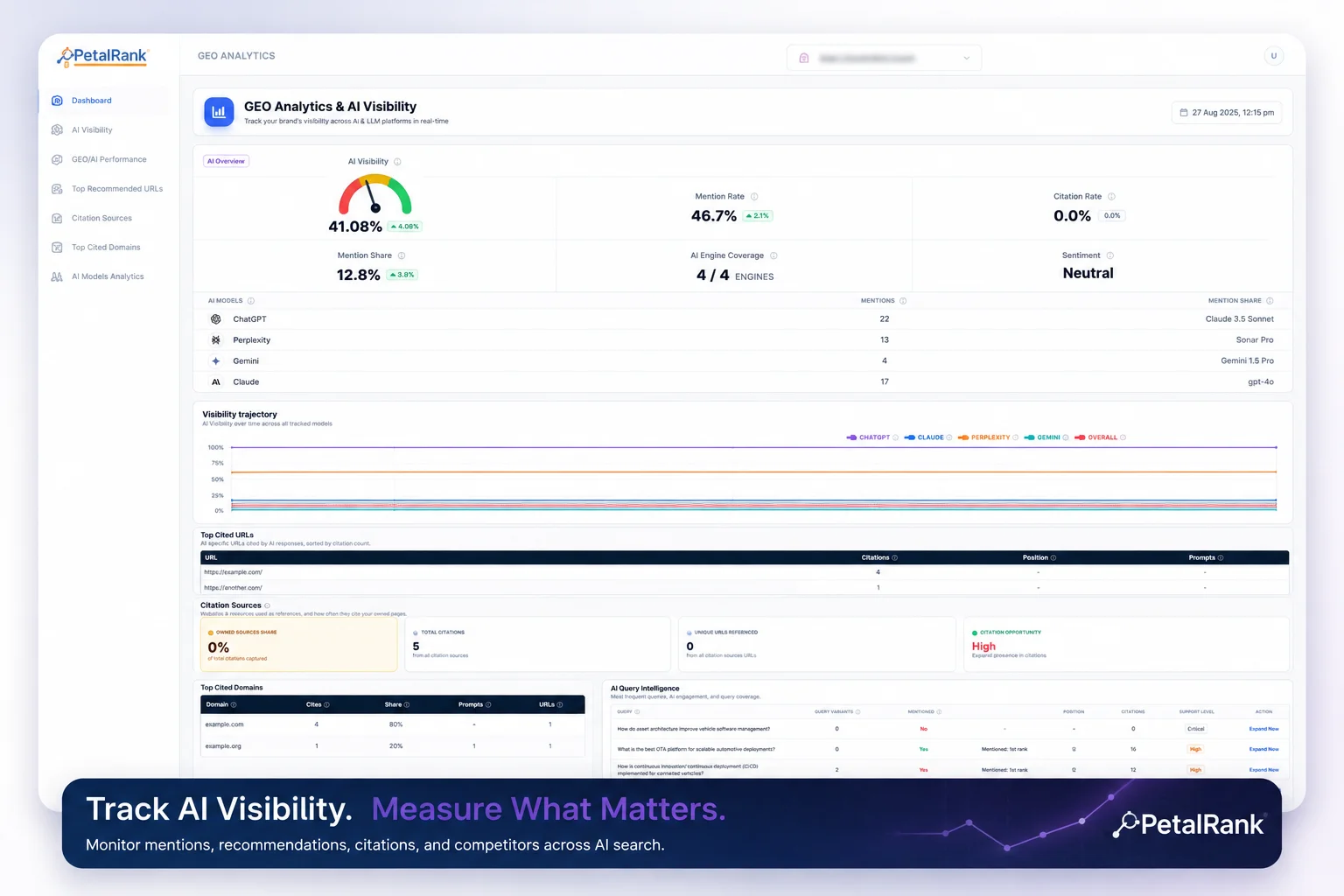
PetalRank turns that manual process into measurable, prompt-level AI visibility tracking.
Instead of checking one prompt and assuming the result represents your overall AI presence, you can track the prompts that matter to your business, compare your visibility with competitors, and see where your brand appears or disappears across AI search and LLM-powered experiences.
You can use PetalRank to monitor how your brand appears in AI search prompts, understand competitors’ visibility, and identify where your brand is mentioned or missed.
Instead of asking:
“Does ChatGPT know my brand?”
You can start asking:
“How visible is my brand across the AI searches that matter to my business?”
That is a much more useful marketing question.
Check your AI visibility with PetalRank
See how your brand appears in AI search, identify visibility gaps, and understand how you compare with competitors.
Check your brand with PetalRank
Start measuring the searches that could influence your next customer
AI search is moving the conversation beyond traditional rankings.
The question is no longer only whether your website ranks when someone searches for your category.
It is also whether your brand enters the conversation when someone asks AI which companies, products or solutions they should consider. And that visibility can be measured.
Start with the commercial questions that matter most to your business.
Track your brand.
Track your competitors.
Watch the sources behind the answers.
Measure the changes over time.
Then use those gaps to decide what your content, authority and SEO strategy should do next.
Because if you don’t measure your brand at the prompt level, you can’t reliably know where you’re visible, where competitors are winning, or what to improve next.
Ready to see your AI visibility?
Check your brand with PetalRank
Frequently asked questions
What is AI visibility tracking?
AI visibility tracking is the process of monitoring how and where your brand appears in AI-powered search experiences for questions relevant to your business. It can include brand mentions, recommendations, citations, competitors and the prompts that trigger your visibility.
Why is AI visibility tracking important?
Traditional SEO tells you where your website appears in conventional search results. AI visibility tracking helps you understand whether your brand is being mentioned, recommended or cited when potential customers ask AI-powered search systems questions about your category.
How do you measure AI visibility?
Start with a consistent set of commercially relevant prompts. Track whether your brand appears, how often it appears, whether it is recommended, which competitors appear, and which sources are cited. Then monitor those signals over time.
What is the difference between AI visibility and traditional SEO visibility?
Traditional SEO visibility focuses primarily on rankings, impressions and clicks in search engine results. AI visibility focuses on how a brand appears within AI-generated answers, recommendations, mentions and citations.
Should I track AI visibility by keyword or prompt?
AI search is better measured through natural-language prompts because users often ask complete questions rather than entering a short keyword. A strong tracking strategy should connect those prompts to search intent, commercial relevance and competitor visibility.
What is AI brand visibility?
AI brand visibility refers to how frequently and prominently your brand appears when users ask AI-powered search systems questions related to your products, services, industry or competitors.
What is the difference between an AI mention and an AI recommendation?
A mention simply means your brand appears in an AI-generated response. A recommendation indicates that the AI system is positioning your brand as an option the user may want to consider. The commercial value of the two can differ significantly.
Why should I track competitors in AI search?
Your competitors may appear in AI-generated answers even when they do not outrank you in traditional search. Tracking them helps identify where they have stronger AI visibility and which prompts represent opportunities for your brand.
What are AI citations?
AI citations are references to sources used to support or inform an AI-generated answer. Tracking them can help businesses understand which websites, publications and other sources are contributing to how their category and brand are represented.
Can AI visibility change from one prompt to another?
Yes. A brand can appear prominently for one question and be absent for another. This is why prompt-level tracking and intent-based segmentation are important.
Is AI visibility tracking a replacement for SEO?
No. Traditional SEO remains foundational. AI visibility tracking adds another layer, helping businesses understand how their brands are discovered and represented in AI-powered search.
How does PetalRank help with AI visibility tracking?
PetalRank brings together keyword research, website audits, technical SEO, content optimization, rank tracking, AI SEO and GEO insights to help businesses understand their visibility across traditional and AI-powered search.
Who should use an AI visibility tracking tool?
SEO teams, SaaS companies, agencies, marketers and businesses that depend on organic discovery can benefit from tracking how their brands appear in AI-powered search, particularly for commercial, comparison and high-intent queries.
