
Search Intelligence: Why modern SEO is about more than rankings
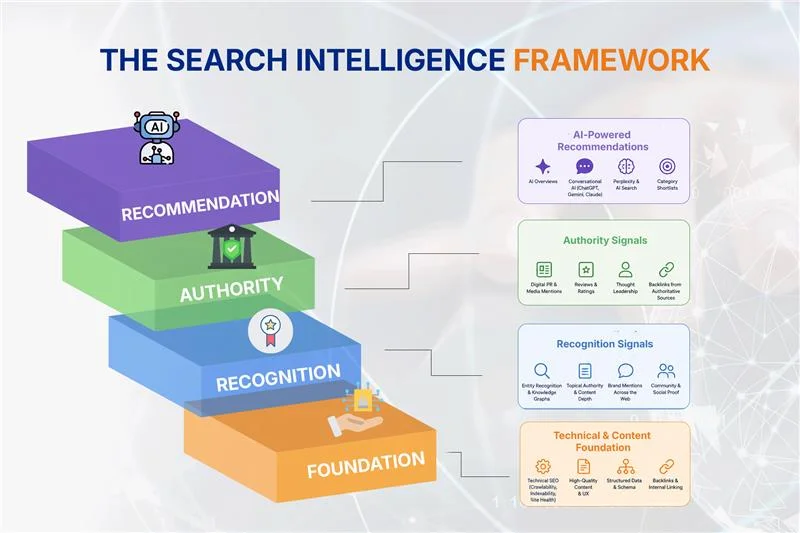
Search is evolving. Rankings still matter, but they are no longer the complete picture. Here’s why modern SEO teams need to think beyond keywords, traffic, and backlinks.
Key takeaways
- Search Intelligence expands traditional SEO by measuring discoverability beyond rankings.
- Rankings remain important, but they no longer explain every customer discovery journey.
- Modern buyers move across Google Search, AI-powered search, review platforms, communities, and industry publications before making decisions.
- Technical SEO, content quality, entity optimisation, digital PR, and brand authority now work together to influence visibility.
- Modern SEO teams need to measure both search performance and AI discoverability.
We think of Search Intelligence as understanding how a business is discovered, recognised, trusted, and ultimately recommended across traditional search, AI-powered search, and the wider digital ecosystem. It builds on SEO by measuring visibility beyond rankings alone.
Search has changed. The way most organisations measure it hasn’t.
Over the past year, we’ve had countless conversations with founders, CMOs, SEO leaders, and marketing teams. Interestingly, very few of those conversations began with rankings.
Instead, they started with observations that sounded surprisingly similar.
“Organic traffic is growing, but it feels like we’re becoming less visible.”
“Our competitors keep showing up in AI-generated answers, even though our SEO is stronger.”
“We invested heavily in technical SEO. Why aren’t we seeing the same level of brand discovery across AI-powered search?”
None of these organisations had neglected SEO. Their websites were technically sound, rankings had improved, organic traffic was healthy, and years of investment in search were beginning to pay off.
The metrics looked healthy. The customer journey told a different story.
Buyers no longer follow a single search journey
For years, customer discovery followed a relatively predictable path.
A buyer searched Google, compared a handful of websites, read a few reviews, and gradually narrowed down their options before speaking to a vendor.
That journey still exists. It simply isn’t the only one anymore.
Today, a software buyer might ask ChatGPT to recommend the best CRM platforms, validate those recommendations through Google AI Overviews, compare vendors on G2, watch product reviews on YouTube, read analyst commentary, browse Reddit discussions, and finally visit a company’s website.
From the buyer’s perspective, this feels like one continuous conversation.
From an SEO perspective, it spans multiple discovery platforms, each influencing trust in distinct ways.
This is one of the most significant shifts search has experienced since the rise of mobile-first indexing.
Search has become an ecosystem rather than a destination.
The numbers suggest this shift is accelerating. The change isn’t based on anecdotal observations alone.
Google has stated that AI Overviews now reach more than 1.5 billion users every month, making AI-generated summaries one of the fastest-adopted search experiences in the company’s history. The implication is simple: discovery is no longer happening in one place. Buyers now move fluidly between search engines, AI assistants, review platforms, communities, and industry content before making decisions.
Industry research also points in the same direction. Multiple studies published over the past year have shown that buyers increasingly combine traditional search engines with AI assistants, review platforms, industry publications, and community discussions before making purchasing decisions. Rather than replacing Google, AI has expanded the number of places where customer discovery begins.
For SEO teams, this creates a new reality.
Visibility is no longer confined to a search engine results page.
It exists wherever customers are looking for answers.
Rankings are still important. They just answer a different question.
This is where many discussions about AI search become unnecessarily polarised.
Some argue that traditional SEO is becoming obsolete. Others see AI-powered search as little more than another technology cycle. We don’t believe either view reflects what’s actually happening.
Technical SEO still matters.
Content quality still matters.
Structured data, site architecture, backlinks, internal linking, page experience, crawlability, and topical authority remain essential components of sustainable organic growth.
Those principles haven’t become less valuable.
If anything, they have become more important because they continue to shape how search engines and AI systems understand the web.
What has changed is the role those signals now play.
Traditional SEO is exceptionally good at helping search engines understand pages.
Modern search increasingly requires helping AI understand businesses.
Those are related challenges.
They are not identical.
As we reviewed more websites and customer discovery journeys, one observation kept repeating itself.
The organisations appearing most consistently in AI-generated recommendations weren’t always the ones with the strongest technical SEO.
Nor were they always the businesses ranking first for every commercial keyword.
More often, they were brands that buyers had already encountered across multiple trusted sources.
Their expertise appeared in industry publications; their products were discussed in comparison articles; their executives contributed thought leadership; customers shared their experiences; and independent sources cited their research. Long before AI recommended those brands, the market had already built confidence in them.
That distinction matters.
Search engines rank pages.
Increasingly, AI recommends brands.
Those are complementary outcomes, but they are influenced by different combinations of signals.
We realised visibility was being measured too narrowly
Working across different verticals, we kept seeing the same pattern.
Strong rankings didn’t always translate into broader discoverability.
For years, SEO has measured success through rankings, clicks, impressions, traffic, and backlinks because those metrics reflected how search engines evaluated websites.
They still do.
The difference is that customer discovery now extends far beyond the search results page.
A business can rank exceptionally well and still remain absent from many of the conversations that influence buying decisions, not because its SEO is weak, but because traditional reporting wasn’t designed to measure every place where discovery now happens.
That’s the distinction that led us to think about search differently.
Rather than asking only “How is our website performing?”, we started asking “How discoverable is this business across the entire search ecosystem?”
That broader perspective is what we now describe as Search Intelligence, not as a replacement for SEO, but as its natural evolution.
From SEO to Search Intelligence
One of the biggest misconceptions about modern search is that AI is replacing SEO. It isn’t. What’s actually happening is that SEO is expanding.
For years, SEO teams have optimised websites to help search engines crawl, understand, and rank pages. That objective hasn’t changed. Search engines still rely on technical signals, content quality, authority, internal linking, structured data, page experience, and hundreds of other ranking factors to determine which pages deserve visibility.
Those fundamentals remain the foundation of every successful SEO strategy.
What has changed is what happens after those pages are discovered.
Increasingly, buyers are no longer choosing from a list of links alone. They’re presented with summaries, comparisons, recommendations, and direct answers generated by AI systems that synthesise information from multiple sources.
That means visibility is no longer determined by a single algorithm or a single platform.
It is shaped by an ecosystem of signals that collectively influence how a business is understood, trusted, and recommended.
That’s why we believe modern SEO has entered a new phase. Not the end of SEO, but the beginning of Search Intelligence.
Traditional SEO vs Search Intelligence
Both are essential. They simply answer different questions.
|
Where do we rank? |
Where are we being discovered? |
|
Which keywords drive traffic? |
Which topics make our brand visible? |
|
Which pages perform best? |
Which content earns recognition and citations? |
|
How healthy is our website? |
How visible is our brand across the search ecosystem? |
|
Which backlinks improve authority? |
Which authority signals influence recommendations? |
|
How many visitors arrived? |
Where did buyers first discover us? |
|
Which pages are indexed? |
Which sources consistently mention or recommend us? |
Search Intelligence doesn’t replace traditional SEO. It gives context to the metrics SEO teams already rely on.
Modern discovery happens in layers
One observation keeps coming back. Buyers rarely discover a business through a single interaction anymore.
Trust develops gradually.
Every search, every mention, every recommendation, and every independent reference contributes another layer of confidence before a prospect ever reaches your website.
We think of modern search as four connected layers.
Layer 1: Discovery
This is where traditional SEO has always excelled.
A customer searches Google.
A page ranks.
Your website becomes discoverable.
Technical SEO, content optimisation, metadata, structured data, Core Web Vitals, and crawlability all influence this stage.
Without strong foundations, the rest of the journey becomes significantly harder.
Layer 2: Recognition
Visibility alone doesn’t create trust.
Once buyers discover a business, they begin validating it.
They compare vendors, read independent reviews, explore analyst research, watch demonstrations, and browse industry communities before forming an opinion.
By this stage, they’re no longer evaluating pages.
They’re evaluating credibility.
Layer 3: Authority
As buyers encounter a brand repeatedly across trusted sources, something important begins to happen.
Recognition turns into authority.
Authority is rarely built through a single backlink or one successful campaign. It emerges when a business consistently earns recognition through independent research, editorial mentions, customer advocacy, thought leadership, and trusted industry references.
These signals collectively influence how both people and AI systems develop confidence in a business.
Layer 4: Recommendation
This is where modern search becomes fundamentally different.
AI systems don’t simply retrieve documents. They synthesise information from multiple trusted sources before generating a recommendation.
When someone asks,
“Which industrial IoT consulting companies should I evaluate?”
or
“What’s the best SEO platform for monitoring AI visibility?”
The system evaluates information gathered across numerous trusted sources before producing a recommendation.
That recommendation represents the cumulative outcome of everything that happened before it.
AI recommendations are often the outcome of everything that happened before: discovery created awareness, recognition built familiarity, authority established trust, and recommendation became the natural result.
Viewed this way, AI recommendations aren’t replacing SEO.
They’re becoming one of its most visible outcomes.
What makes Search Intelligence valuable is that it connects every layer of modern discovery. Traditionally, those layers have been measured in isolation.
Traditionally, SEO, PR, marketing, customer success, and social teams have each measured different aspects of visibility. Customers don’t experience those channels separately, and increasingly, neither do AI systems.
Every interaction contributes to a single perception of your business.
Search Intelligence connects those fragmented signals into one broader view of discoverability.
Instead of asking whether a page ranks, it asks whether a business is consistently earning visibility, authority, and trust wherever customers seek answers.
That perspective doesn’t replace traditional SEO reporting.
It makes it significantly more complete.
The next generation of SEO won’t replace rankings
Every major shift in search has expanded SEO rather than replacing it.
Mobile-first indexing didn’t eliminate desktop SEO.
Core Web Vitals didn’t replace technical SEO.
Helpful Content didn’t replace content strategy.
AI-powered search won’t replace SEO either.
It will expand the scope of what SEO teams are expected to measure.
Tomorrow’s highest-performing organisations won’t abandon rankings.
They will complement them with a broader understanding of discoverability.
That’s where we believe Search Intelligence fits.
Not as another dashboard.
Not as another isolated metric.
It is the framework that connects every signal influencing how customers discover, evaluate, trust, and ultimately choose a business in the era of AI-powered search.
Search Intelligence changes what SEO measures
One of the easiest ways to misunderstand Search Intelligence is to think of it as another metric to add to your SEO dashboard.
Rather than adding another metric to your dashboard, Search Intelligence expands the way visibility is measured. Traditional SEO explains how pages perform. Search Intelligence explains how businesses are discovered across the broader search ecosystem.
The difference may seem subtle, but its impact is significant.
A page can rank well without building meaningful brand recognition.
Likewise, a brand can become highly visible across AI-powered search experiences by being consistently referenced, cited, and discussed beyond its own website.
The strongest organisations increasingly achieve both.
The signals behind modern discoverability
AI-powered search doesn’t rely on a single ranking factor. It builds confidence by connecting information from multiple trusted sources.
Some of the signals influencing modern discoverability include:
- Strong technical SEO and crawlability
- Topical authority built through consistent expertise
- Structured data that improves content understanding
- High-quality editorial backlinks and digital PR
- Brand mentions across trusted publications
- Independent reviews and comparison websites
- Expert commentary and thought leadership
- Consistent entity recognition across the web
None of these signals is new.
What’s changing is how they work together.
Rather than evaluating pages in isolation, modern search increasingly evaluates the overall confidence surrounding a brand.
Why this matters for SEO teams
For years, SEO success was measured by improvements in rankings, traffic, and conversions.
Those metrics remain essential.
However, they no longer answer every question marketing teams are being asked.
Today, leadership teams also want to know:
- Why are competitors appearing in AI-generated recommendations?
- Which brands are becoming the default choice in our category?
- Where are customers discovering us before they reach our website?
- Which signals influence AI-powered search visibility?
Those aren’t traditional SEO questions.
They’re Search Intelligence questions.
As search continues to evolve, we believe SEO teams will need to answer both.
Not because rankings matter less.
Because customer discovery has become much broader than rankings alone.
Search Intelligence complements every SEO investment
One concern we often hear is whether organisations need to choose between traditional SEO and AI-powered search.
We don’t believe they do.
Technical SEO remains the foundation.
Content remains the engine.
Backlinks continue to build authority.
Digital PR strengthens credibility.
Entity optimisation improves understanding.
Search Intelligence simply connects those efforts into a broader view of discoverability.
It helps answer a question that businesses increasingly care about:
Are we only ranking, or are we genuinely being discovered wherever customers look for answers?
What this means for modern SEO teams
Every major evolution in search has expanded the role of SEO rather than replacing it.
When mobile became the primary way people accessed the web, SEO evolved.
When page experience became a ranking signal, SEO evolved.
When structured data became essential for rich results, SEO evolved.
AI-powered search is no different.
It doesn’t make traditional SEO obsolete.
It raises the standard for what visibility means.
The organisations that perform best over the next few years won’t necessarily publish the most content or build the most backlinks.
They will build the strongest digital presence around their expertise.
They will create original research, earn trusted citations, develop recognised entities, invest in authoritative content, and become businesses that both search engines and AI systems can confidently reference.
That’s a broader challenge than improving rankings.
It’s also a more valuable one.
Why this shift matters
One observation keeps coming up whenever we discuss this with marketing leaders.
Nobody is asking for fewer SEO metrics.
They are asking for more complete ones.
Rankings still matter.
Organic traffic still matters.
Technical SEO, backlinks, structured data, topical authority, and content quality remain the foundation of long-term search performance.
What has changed is that they no longer explain the entire customer discovery journey.
Modern visibility extends across search engines, AI assistants, industry publications, review platforms, communities, podcasts, videos, analyst research, and countless other sources that influence how buyers evaluate businesses.
We believe that understanding the broader picture is what Search Intelligence is ultimately about.
Not another dashboard.
Not another acronym.
A more complete way of understanding how businesses earn visibility in modern search.
The next question every SEO team should ask
For years, SEO teams have asked:
Where do we rank?
It remains one of the most important questions in digital marketing.
But we don’t believe it’s the only one anymore.
As search continues to evolve, another question is becoming equally important.
Where are customers discovering us before they ever visit our website?
The answer won’t come from rankings alone.
It will come from understanding every signal that shapes trust, authority, recognition, and recommendation across the modern search ecosystem.
That’s the opportunity we believe Search Intelligence represents.
The next era of search has already begun.
Search is no longer defined by a single search engine or a single results page.
It has become an ecosystem where traditional search, AI-powered search, trusted publications, communities, review platforms, and expert content collectively influence how businesses are discovered.
SEO remains the foundation of that ecosystem.
Search Intelligence builds on it.
The organisations that recognise this shift early won’t stop investing in technical SEO or content marketing.
They will expand their thinking beyond rankings and begin measuring the broader signals that influence discoverability, authority, and recommendation.
Search has always evolved, and the organisations that adapt first tend to build lasting advantages. Rankings will continue to matter, but understanding how customers discover, trust, and recommend brands across the broader search ecosystem may become the defining advantage of the next decade.
In the next era of search, the brands that earn the most visibility won’t simply rank well. They will become part of the answer.
Where does your business stand?
If customer discovery now extends beyond rankings, understanding your visibility requires looking beyond rankings, too.
Search Intelligence helps answer questions that traditional SEO reporting was never designed to measure, including AI-powered search visibility and brand discoverability, as well as authority signals and competitive presence across the modern search ecosystem.
FAQs
What is Search Intelligence?
Search Intelligence measures how a business is discovered, trusted, and recommended across search engines, AI-powered search, and the wider digital ecosystem—not just how well its pages rank.
How is Search Intelligence different from SEO?
SEO improves rankings. Search Intelligence expands that view by measuring how your brand is discovered, understood, and recommended wherever customers search for answers.
Why are rankings no longer enough?
Rankings show where your pages appear. They don’t show whether your brand is being recommended across AI-powered search, review platforms, industry publications, and other trusted sources.
How does AI-powered search influence discoverability?
AI doesn’t simply rank pages; it synthesises information from multiple trusted sources. Brands with stronger authority, recognition, and credibility are more likely to be recommended.
What signals contribute to Search Intelligence?
Search Intelligence combines technical SEO, content quality, structured data, brand authority, entity recognition, digital PR, reviews, and AI recommendations to measure overall discoverability.

Comments are closed.